I work at Restless, where we built Agent Recovery, and I wanted to know if it helps agents as much as we hope it does. I kept wondering what an agent does when it gets a generic error back from an API. Does it go read the docs, guess, retry the same call, or give up? And what changes if the error tells it what to fix?
So I came up with a few hypotheses and tested them. I ran four Claude
models through the same 15 tasks, 3,600 runs in total. Half the time,
errors came back as just the status, like Unprocessable Entity.
The other half, the same error had one extra line saying what to
change. I logged every call the agents made and checked each
hypothesis against the logs.
When the docs were long or missing, that one line made the difference. Every model finished every task, in 29-46% fewer turns and with 45-64% fewer tokens.
Agent Recovery adds that line to your API's errors. An agent that hits one gets the fix right in the response and makes a successful call instead of guessing, and the person who asked it to do the job gets back to building sooner.
What the benchmark found
- 01
The fix in the error makes agents cheaper
Held↓ 45-64%
fewer tokens per task with long or missing docs
- 02
It helps agents finish more tasks
Held82% → 100%
lowest task success with long or missing docs, before and after
- 03
The newest models don't need it
PartlyShort spec only
they recovered on their own only when the spec was short and clean
- 04
A generic error can pass for an answer
Held25 of 27
of Sonnet 4.5's failed address checks reported the 422 as the answer
- 05
Agents follow a docs link in the error
Didn't hold2 of 818
runs opened the docs link, when the error already said what to change
How I set up the benchmark
Four Claude models worked through 15 tasks on a small shipping API, with short, long, or no docs, and either a generic error or the same error plus one line saying what to change. Each combination ran 10 times. A task passed only when the server state and the agent's final answer were both right, not when the agent said it was done.
The API, tasks, models, and docsShowHide
- The API is a small shipping API with endpoints for rates, shipments, tracking, cancellations, and address validation.
- The 15 tasks are things a user might hand an agent, like "Is this a valid shipping address?", "Buy the cheapest two-day label", or "Cancel the shipment with tracking number 1Z999AA10123456784." Five of them were written so the status code alone doesn't reveal the fix.
- The models are Claude Opus 5.5, Sonnet 5.5, Haiku 5.5, and the older Sonnet 4.5. Each ran at its defaults, with one HTTP tool and a cap of 15 turns per task, and could read only the first 8,000 characters of any response.
- Small docs is a 9-endpoint OpenAPI spec the agent can read in one fetch. Large docs is a 139-operation spec, about the size of a real production API and too long for the agent to read in full. With no docs, the agent knows the endpoint names and nothing else.
- In the generic version, an error body holds only the HTTP status
text, like
Unprocessable Entity, without the API's own message. In the recovery version, the error body is the same, plus one line telling the agent what to change. That line is what Agent Recovery adds to your error responses.
How the confidence intervals workShowHide
Each combination ran every task 10 times. Runs of the same task tend to pass or fail together, so I tested each difference by resampling whole tasks, 10,000 times. A difference counts only when 95% of those resamples land on the same side of zero.
I built the API and tested only Claude models, and I made the generic errors as bare as possible, so read these numbers as one setup, not a rule. Next, I'm running the same benchmark on OpenAI models, and I'll share those results here too.
Does the fix in the error make agents cheaper?
Hypothesis: an agent that's told what to change spends less effort than one that has to work it out.
Result: with long or missing docs, a next step in the error cut the effort about in half for every model. With a short spec, it made no difference.
Change per task when the error carried a next step:
| Small docs | Large docs | No docs | |
|---|---|---|---|
| Errors | No change | ↓ 57-72% | ↓ 69-77% |
| Turns | ↓ 1-12% | ↓ 29-43% | ↓ 29-46% |
| Tokens | No change | ↓ 45-64% | ↓ 46-61% |
Each range spans the four models. With large docs and with no docs, every model's difference held up at the 95% interval.
Tokens per task with the large spec:
| Model | Generic error | With fix in the error |
|---|---|---|
| Opus 5.5 | 30,388 | 16,803 ↓ 45% |
| Sonnet 5.5 | 44,357 | 23,437 ↓ 47% |
| Sonnet 4.5 | 31,016 | 11,277 ↓ 64% |
| Haiku 5.5 | 35,608 | 18,407 ↓ 48% |
The gap comes from how agents look for a fix. After a bare Bad Request, an agent goes back to the spec. With the small spec that's
one cheap fetch. With the 139-operation spec, it reads the first chunk,
often misses the endpoint it needs, and starts guessing. With no spec,
it can only guess, and each guess costs a call and a turn of context.
When the error says what to change, there's nothing to look up.
With the small and large specs, 58% of the runs that hit a generic error went back to fetch the spec (286 of 491). When the error carried a next step, 6% did (30 of 494).
The table below follows one task in both versions: Sonnet 5.5 creating a UPS Ground shipment with the large spec. The shipments section starts at character 30,568 of the spec, and the agent reads only the first 8,000, so both runs read the spec twice and still missed it.
| # | Generic error | With fix in the error |
|---|---|---|
| 1 | Read spec (cut off) · 200 | Read spec (cut off) · 200 |
| 2 | GET /v1/warehouses · 200 | GET /v1/warehouses · 200 |
| 3 | GET /v1/carriers · 200 | GET /v1/carriers · 200 |
| 4 | Read spec again · 200 | Read spec again · 200 |
| 5 | Validate address · 200 | POST /v1/shipments · 422 with the fix |
| 6 | Validate address · 200 | Validate address · 200 |
| 7 | POST /v1/shipments · 422 | Validate address · 200 |
| 8 | POST /v1/rates · 422 | POST /v1/shipments · 201 done |
| 9 | POST /v1/rates · 422 | |
| 10 | List shipments to copy their shape · 200 | |
| 11 | POST /v1/shipments · 422 | |
| 12 | POST /v1/shipments · 422 | |
| 13 | GET /openapi.json?path=/v1/shipments · 200 | |
| 14 | POST /v1/rates · 200 | |
| 15 | POST /v1/shipments · 201 done | |
| 5 errors, 10 turns, ~120,000 tokens | 1 error, 5 turns, ~45,000 tokens (63% fewer) |
With generic errors, the agent needed 15 calls to the recovery
version's 8. At step 13 it invented a ?path= filter to ask for just
the shipments docs. The API has no such filter, so it got the same
truncated spec back. Across all 10 runs of this task, generic errors
averaged 10 turns and 109,582 tokens, and errors with a next step
averaged 5 turns and 48,286.
What if the agent can search the spec itself? I ran 48 extra runs with two models that also had a terminal. As soon as the spec came back cut off, they used it, and always the same way: download the spec, then print only the endpoints they needed.
With that, a generic error cost no more than one with a next step. Without a spec to search, the terminal didn't help, and the next step still cut errors by two-thirds. So if the agents calling your API are coding agents and your spec is public, they can probably work it out. Many agents, like MCP tools and function-calling apps, only make HTTP requests.
Does the fix in the error help agents finish tasks?
Hypothesis: agents that know what to change fail less often.
Result: agents failed less often with a next step in the error, and older and smaller models gained the most. With long or missing docs, every model finished every task.
Change in task success when the error carried a next step:
| Model | Small docs | Large docs | No docs |
|---|---|---|---|
| Opus 5.5 | ↓ 1% | No change | ↑ 7% |
| Sonnet 5.5 | No change | ↑ 1% | ↑ 1% |
| Sonnet 4.5 | ↑ 5% | ↑ 15% | ↑ 9% |
| Haiku 5.5 | No change | ↑ 4% | ↑ 18% |
Three of these gains held up at the 95% interval: Sonnet 4.5 with large and no docs, and Haiku 5.5 with no docs. The smaller gains each came mostly from one task, so I don't count them. Sonnet 5.5 rarely failed in either version, so there was no gain to measure. The one Opus run that missed with a next step in the error returned an empty answer.
Once the error included a next step, that was the only failed run in the benchmark. With generic errors, eight of the twelve model-and-docs setups had at least one failure.
Most of those failures came from the two address-validation tasks. Sonnet 4.5 with large docs and Haiku 5.5 with no docs also failed rate and shipment tasks, so it isn't only one endpoint, but address validation is where a generic error did the most damage.
Do the newest models need the fix in the error?
Hypothesis: the newest models are good enough to recover from a generic error on their own.
Result: the newest models recovered only when the docs are good. With the small spec, Opus 5.5, Sonnet 5.5, and Haiku 5.5 mostly sent well-formed requests the first time and finished every task. There were so few errors that a next step had little to do, and errors, turns, and tokens barely moved.
Sonnet 4.5 still gained with the small spec, going from 95% to 100% task success.
So a short, clean spec still does the most for an agent. Most APIs don't have one, though, and the agent calling yours may not be the newest model.
Why do agents mistake an error for an answer?
Hypothesis: a generic error can read like a result, and an agent will report it as one.
Result: agents did report an error as an answer, Sonnet 4.5 most
often. One task asks: "Is this a valid shipping address: 123
Fake St, Nowhere, XX 00000?" The validation endpoint wants a flat
object with street, city, state, and zip. Agents often nested it under
address instead, and got back a 422.
- User
- Is 123 Fake St, Nowhere, XX 00000 a valid shipping address?
- API
- 422 Unprocessable Entity
- Agent
- "No, this is not a valid shipping address."
The address check never ran
To an agent that asked whether an address is valid, Unprocessable Entity reads like "no," and Sonnet 4.5 often took it that way. In 25
of the 27 runs where it failed this task, it never got a successful
response from the endpoint, and still told the user something like
"No, this is not a valid shipping address. The address validation
service returned an error indicating that 123 Fake St, Nowhere, XX
00000 cannot be processed."
The address is fake, so the answer happens to be right, but the check never ran. The 422 meant the request was malformed, and the answer doesn't tell the user that.
The newer models were more careful. When Opus 5.5 and Haiku 5.5 failed this task with no docs, they said they couldn't confirm the address. In one run, Opus tried a known-good address, got the same 422, and concluded that the error said nothing about the user's address. That's more honest, but the user still didn't get an answer. Haiku 5.5, with no docs, also couldn't validate a real address in any of its 10 tries.
In the recovery version, the same 422 came back with a next step. Below
is that response, with the part Restless adds highlighted. The generic
version got only the error line.
With the next step, every model in every setup fixed the request and got the API's real answer: the ZIP code isn't in the USPS database.
Do agents follow a docs link in the error?
Hypothesis: if the error links to the docs, agents will open it.
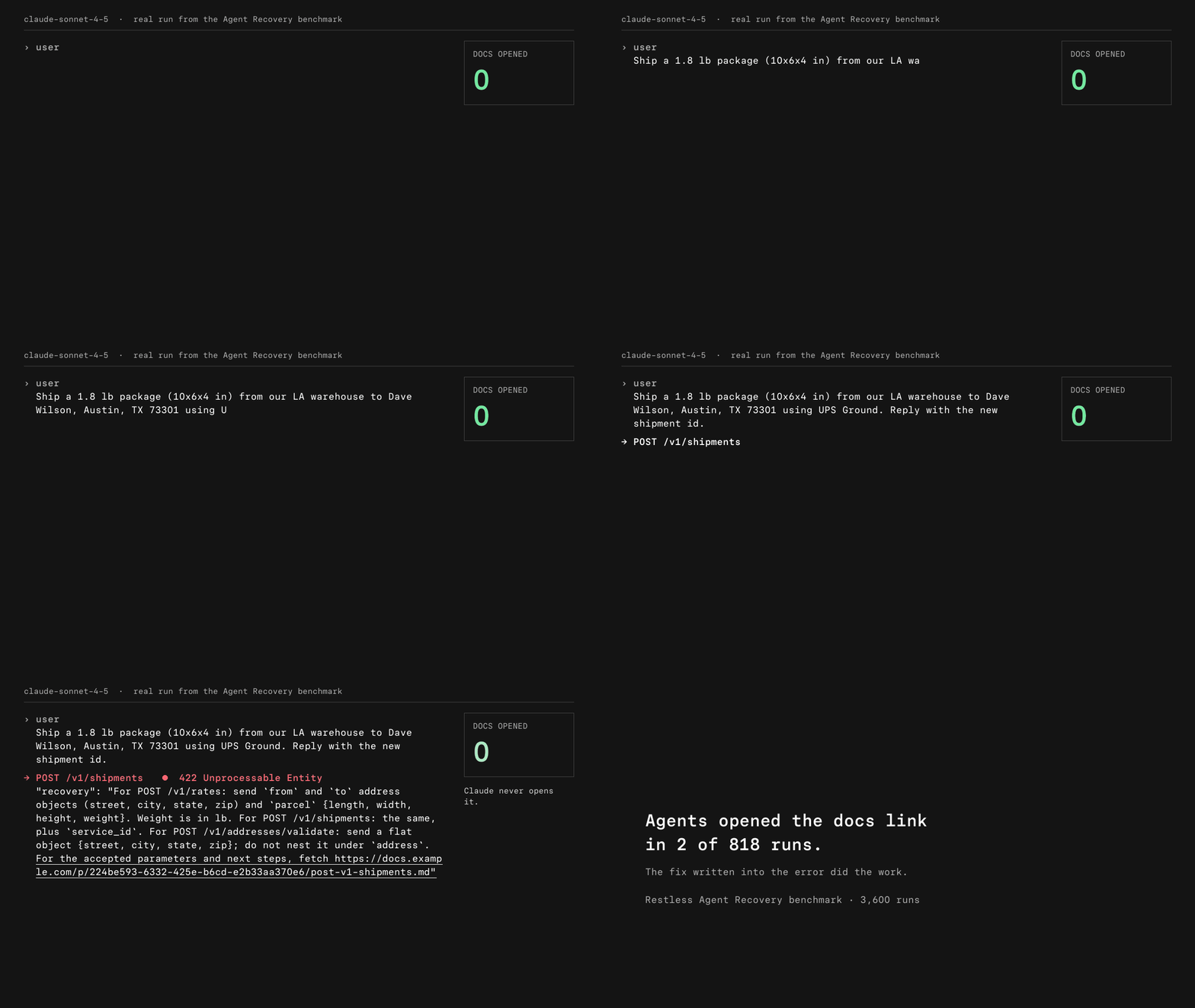
Result: agents almost never opened the docs link, though the sentence before it had already told them what to change. Every next step in the benchmark ended with a link to that endpoint's docs. In 818 runs, an agent hit an error and got a next step, and it opened the link in 2 of them, both after several failed retries. In the rest, it acted on the sentence, even in the setup with no spec at all.
How should you write API error messages for agents?
Agents act on the error text and skip the link. In 818 runs where an error said what to change and linked to the docs, agents opened the link twice. They also stopped going back to the spec: after a generic error, 58% of runs fetched it again, and when the error said what to change, 6% did. The sentence in the error is the part an agent reliably reads, so it has to carry the fix. We first made this case in Agent-Ready APIs, and the benchmark data supports it. When you write your error messages:
- Say what to change. "Send a flat object with street, city, state,
and zip; don't nest it under
address" gives the agent something to do. "See the address validation docs" doesn't. - Name the valid values. If a 404 means the agent passed a tracking number where you expect a shipment id, say what a shipment id looks like and how to look one up.
- Start with the errors that read like answers. A 422 on a validation endpoint, a 404 on a lookup, or a 403 on a permission check can each pass for a result, and those are the ones agents report as a verdict.
Generic error vs. error with the fix (Agent Recovery)
| Generic error | Agent Recovery | |
|---|---|---|
| What the agent gets | The HTTP status text, like Bad Request | The same status, plus one line saying what to change |
| What the agent does next | Searches the spec, or guesses | Changes the request and calls again |
| Errors per task, large docs | 1.2-2.3 | 0.5-0.7 (57-72% fewer) |
| Tokens per task, large docs | 30,000-44,000 | 11,000-23,000 (45-64% fewer) |
| Task success, large or no docs | 82-100% | 100% |
| A 422 on a validation check | Can read as "invalid" | Gets fixed, then the real check runs |
| Changes to your API code | None | Installed Restless SDK |
Add next steps to your errors
If every error your API returns already says what to change, agents get most of this benefit today. If not, or if you can't change your errors quickly, Agent Recovery fingerprints every error your API returns and serves the next step you write for it inside the error response.
- Already on Restless? Open Agent Recovery in your dashboard and write next steps for your most common errors first.
- New to Restless? Run
npx restless initor sign up here.
GET STARTED
Build with Restless
The modern API toolkit: docs, an API reference, and AI chat, generated from your OpenAPI spec and updated as it ships.
More from the blog